
The Ultimate Kindergarten Readiness Checklist
Starting kindergarten is a huge milestone, and every parent wonders if their child is truly ready.
That’s why many schools and families use kindergarten readiness screenings, evaluations that look at your child’s skills before that first day of school.
These screenings can highlight areas where a child might need a little extra support, helping you address any gaps early on.
In this guide, we’ll explain what “kindergarten ready” really means and walk you through the ultimate readiness checklist across multiple areas of development. By the end, you’ll know exactly what to look for and how to help your child practice and grow the skills they’ll need for kindergarten at home.
What Does Kindergarten Ready Really Mean?
Kindergarten readiness isn’t a race, and it doesn’t just mean knowing the academic basics. It’s also about social and emotional factors. Kindergarten readiness means a child has a willing attitude and confidence in the learning process.
Your Go-To Kindergarten Readiness Checklist
So what skills does a “kindergarten-ready” child typically have? We’ve compiled the ultimate kindergarten readiness checklist, organized into five key areas of development. You can use this checklist as a practical tool. As you observe your child in everyday situations, check off the items that they can do consistently.
Kindergarten Readiness Checklist
Download a printable version of this checklist here.
-
Kindergarten Readiness Checklist Pg 1
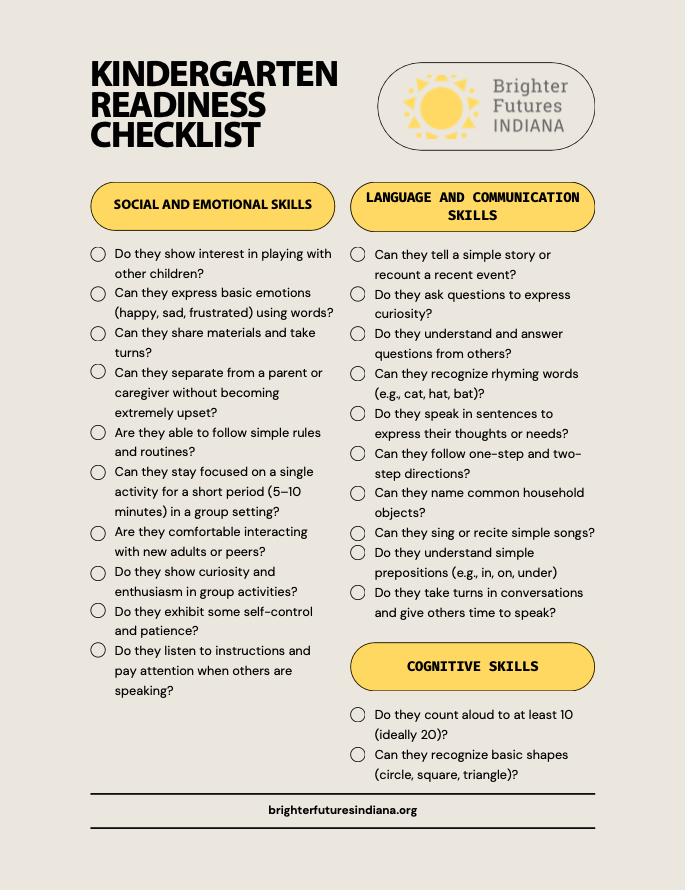
-
Kindergarten Readiness Checklist Pg 2
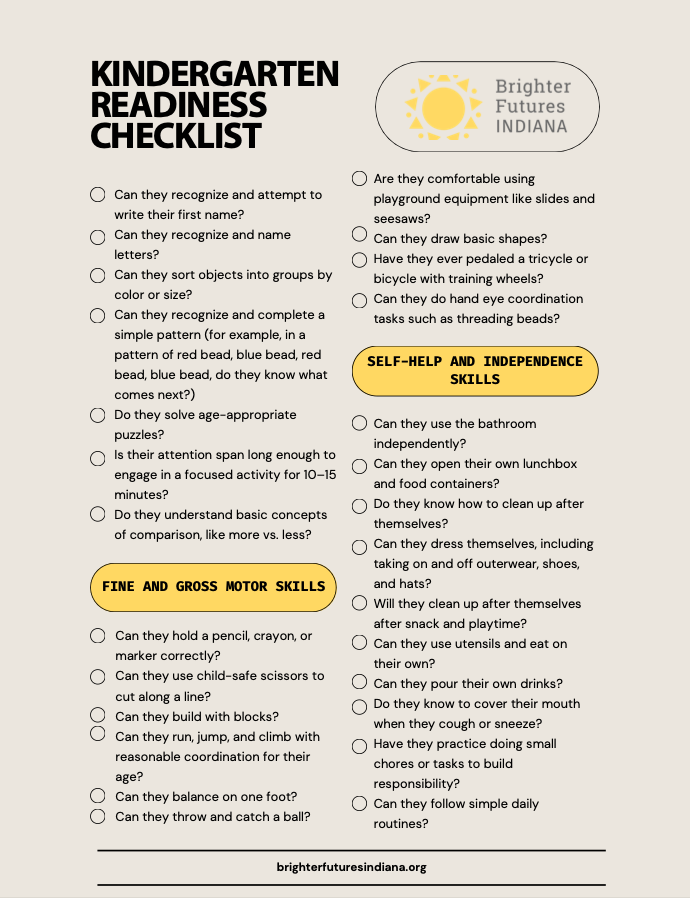
Social and Emotional Skills
Before kindergarten, children who have developed basic social and emotional skills are more prepared. These skills lay the groundwork for a positive learning experience. Being able to get along with others, manage feelings, and follow routines makes the transition to a classroom much smoother.
Here are a few questions to ask yourself about your child’s social and emotional readiness:
Do they show interest in playing with other children?
Can they express happiness, sadness and frustration using words?
Can they share materials and take turns?
Can they separate from a parent or caregiver without becoming extremely upset?
Are they able to follow simple rules and routines?
Can they stay focused on a single activity for fine to 10 in a group setting?
Are they comfortable interacting with new adults or peers?
Do they show curiosity and enthusiasm in group activities?
Do they exhibit some self-control and patience?
Do they listen to instructions and pay attention when others are speaking?
Language and Communication Skills
Strong language skills like speaking and listening make it easier for kids to learn, since they can ask questions and comprehend what’s being taught.
Here are a few questions to ask yourself about your child’s language and communication readiness:
Can they tell a simple story or recount a recent event?
Do they ask questions to express curiosity?
Do they understand and answer questions from others?
Can they recognize rhyming words (e.g., cat, hat, bat)?
Do they speak in sentences to express their thoughts or needs?
Can they follow one-step and two-step directions?
Can they name common household objects?
Can they sing or recite simple songs?
Do they understand simple prepositions like in, on or under?
Do they take turns in conversations and give others time to speak?
Cognitive Skills
Cognitive skills develop when child learns new concepts, solves simple problems, and begins to understand the world around them. Strengthening these skills now will give your child a head start in academics.
Here are a few questions to ask yourself about your child’s cognitive readiness:
Do they count aloud to at least 10, ideally 20?
Can they recognize circles, squares and triangles?
Can they recognize and attempt to write their first name?
Can they recognize and name letters?
Can they sort objects into groups by color or size?
Can they recognize and complete a simple pattern (for example, in a pattern of red bead, blue bead, red bead, blue bead, do they know what comes next?)
Do they solve age-appropriate puzzles?
Is their attention span long enough to engage in a focused activity for 10 to 15 minutes?
Do they understand basic concepts of comparison, like more vs. less?
Fine and Gross Motor Skills
Fine and gross motor skills are a child’s physical development. Gross motor skills involve large movements like running and jumping, while fine motor skills involve precise hand and finger movements like drawing or buttoning a coat. Having developed motor skills helps a child succeed in kindergarten and makes them feel more capable.
Here are a few questions to ask yourself about your child’s fine and gross motor skills readiness:
Can they hold a pencil, crayon, or marker correctly?
Can they use child-safe scissors to cut along a line?
Can they build with blocks?
Can they run, jump, and climb with reasonable coordination for their age?
Can they balance on one foot?
Can they throw and catch a ball?
Are they comfortable using playground equipment like slides and seesaws?
Can they draw basic shapes?
Have they ever pedaled a tricycle or bicycle with training wheels?
Can they do hand-eye coordination tasks such as threading beads?
Self-Help and Independence Skills
The more your child can do for themselves, the more confident and comfortable they’ll feel stepping into a kindergarten classroom. Self-help and independence skills can reduce stress in children and help the whole class run more smoothly.
Here are a few questions to ask yourself about your child’s self-help and independence skills:
Can they use the bathroom independently?
Can they open their own lunchbox and food containers?
Do they know how to clean up after themselves?
Can they dress themselves, including taking on and off outerwear, shoes, and hats?
Will they clean up after themselves after snack and playtime?
Can they use utensils and eat on their own?
Can they pour their own drinks?
Do they know to cover their mouth when they cough or sneeze?
Have they practiced doing small chores or tasks to build responsibility?
Can they follow simple daily routines?
What Should You Do If Your Child Isn’t Ready for Kindergarten?
After going through the checklist, you might find there are a few areas where your child needs a boost.
First off, take a deep breath. It’s OK.
Plenty of kids need a little more time to develop certain skills. Here are some practical steps you can take if you’re concerned about your child’s kindergarten readiness:
Focus on targeted skill-building at home. Identify the areas where your child has room for improvement and find fun ways to practice those skills in daily life. For example, if they need to work on fine motor skills (pencil, scissors use), give them playdough, string beads, or snip paper for art projects to strengthen those little fingers. Check out this article for more activities to do at home.
Try games to boost development. There are many great resources on the Brighter Futures blog with game ideas for preparing your child for kindergarten. For instance, we suggest math games for hands-on learning and improv games to learn more about emotions.
Enroll your child in an early childhood program. An early childhood program can help your child build the skills they need to start kindergarten. Early childhood education is also linked to better success later in life. In fact, children who receive early childhood education are 25% more likely to graduate from high school and four times more likely to get a bachelor’s degree. If you enroll in an early childhood program, be sure to practice good attendance, as this will help your child with cognitive growth, establishing routines, and academic readiness.
FAQs
-
Should I put my child in kindergarten at 5 or 6?
Most children start kindergarten at age 5. However, it’s not mandatory. Indiana doesn’t require school attendance until age 7. If your child just turned 5 and you feel like they aren’t ready, you can wait until 6. Some parents of summer-born children choose to wait an extra year to give the child more time to hit key developmental milestones.
-
Should my 5-year-old go to pre-K or kindergarten?
If your child is 5 and meets the kindergarten cutoff, you have the option to start kindergarten. However, if you feel your child could benefit from more social or academic preparation, another year of high-quality pre-K can be helpful. Consider your child’s confidence and skill levels and make the decision you think is best for their unique needs.
-
Is delaying kindergarten good for a child?
It depends on the child and their social, emotional, and cognitive readiness. There are advantages to starting kindergarten and waiting a year. It will come down to your child’s individual readiness.
-
How common is redshirting in kindergarten?
“Redshirting” describes a parent delaying sending their child to kindergarten for one year. National rates of redshirting fall between 4-14% depending on the year.
If you decide to wait to send your child to kindergarten, but you’re still looking for a high-quality child care program for them, check out this health and safety checklist. As you visit a potential program, you can use this to determine if it’s a safe place for your child.